Thursday, April 22, 2010

The importance of 350 - and doing something about it

Happy Earth Day.  For today's environmental dashboard series, we're focusing on one number in particular: 350.

350 is a "tipping point" number.  It is the safe upper limit for carbon dioxide in our atmosphere.  Below 350 ppm,  the climate continues to be hospitable to the lives that we enjoy living - lives with comfortable temperatures, mild weather, arctic ice, predictable ocean flows, and happy coral reefs teeming with life.

Above 350ppm, there are very negative consequences - extreme weather, droughts in some places, unpredictable ocean flows, dying coral reefs, diminishing ice in the Arctic and Antarctic, the loss of Pacific Island nations, and so on. 

The bad news: we're already at 387ppm, well past 350.

The good news: we can still do something about it.  Like someone who's just been told that they've put on 20 pounds too many for good health, we can start working towards diminishing the carbon dioxide in the atmosphere.


Hey, where did this 350 come from, anyway?
Up until late 2007, an upper limit number didn't really exist.  There were some guesses, such as doubling the amount of carbon dioxide concentration in the atmosphere from the Industrial Revolution days, and calling that it.  After seeing the dramatic reduction in Arctic Ice during the summer of 2007, a number of scientists decided to take a more thorough approach.


NASA's Jim Hansen, along with a team including Makiko Sato, Pushker Kharecha, and Valerie Masson-Delmotte, among others, took a close look at historic data and determined that 350 is the safe upper limit.  The report that they produced is publicly available, you can download it here.  If you find the technical terms a bit confusing, check out the really compelling summary on the last few pages.

So what do we do about that?
There's a lot that everyone can do, both as individuals and as nations.  As the United States, we're in the best position to do something, since we're both one of the largest energy consumers and one of the largest emissions producers.

As an individual
  • Be conscientious about energy consumption.  Not only turning off unused lights and limiting unnecessary electricity use, but also reconsidering things like your daily commute.  Perhaps the bus does take 15 minutes longer, but it may be worth it.
 
  • Consider the climate impact of the goods and services that you consume.  In the Bay Area, more and more restaurants are indicating on their menus which options are environmentally friendly.  It doesn't mean that you always have to choose those options, but awareness can often drive action. 
 
  • Offset your carbon usage.  Organizations like CarbonFund.org make it easy for you to purchase carbon credits to offset your energy usage and emissions.  I offset the average carbon usage for my family today.

As a country
It's going to take concerted effort to reduce atmospheric carbon dioxide levels to within the safe range.  That calls for national solutions in addition to local and individual ones. Here are some ways to get involved:
  • Check out 350.org  350.org is a helpful site with information about the 350 movement and how you can take action. 

For more info, here are some great resources:

Wednesday, April 21, 2010

Ode to the blue bin - America's wastestream and what we're doing about it

Continuing our 40th Anniversary of Earth Day series, here's an executive look at what happens to all of our stuff after we think that we're done with it.

We have a lot of stuff, we have a lot of trash
Along with the rise in American disposable income and wealth over the past century has come a rise in what we dispose of.  As the Environmental Protection Agency calculates it, the amount of solid waste generated in a year has gone from 88 million tons in 1960 to nearly 250 million tons today.

And it's not just because there are more Americans.  The amount of trash generated each day by an American has gone from 2.7 pounds to 4.5 pounds in the same period.  In a year, that adds up to 0.8 tons per person.


Hey, you can see our trash from space!
There are two man-made constructions that you can see easily from space.  One is the Great Wall of China.  The second is the Fresh Kills landfill site on Staten Island,the repository of New York City trash since it opened in 1948.  It's 2,200 acres of fun, rising to 225 feet in some spots.  Now turned into a park, it looks rather pretty now, but I wouldn't go digging too deep.

We are running out of landfills, however, for all of our trash. From 1979 to 1995, the number of landfills dropped by 84%.  Landfills are closing at the rate of 1 per day, according to the Clean Air Council.

What is all this stuff?
The majority of what we throw out is made up of paper, followed by yard trimmings, food scraps, and plastics. 


Seen in another way, a lot of what goes into the waste stream is -- packaging.  That's your aluminum can, your disposable grocery bag, your takeout food container. We do love convenience.  According to the Clean Air Council, Americans throw away 2.5 million plastic bottles every hour.  Americans toss out enough paper and plastic cups, forks and spoons every year to circle the equator 300 times.

 
2.5 million plastic bottles are thrown out every hour.

And that's just the small stuff.  Every day, 20,000 American cars and 4,000 trucks and buses are disposed of.


The good news - we can recycle a lot of this, and we are doing more and more of it
 Americans now recycle about 83 million tons of discarded material a year.  This is a huge growth since the early 1980's.  About 1/3rd of waste is now headed to the recycler.

In 1980, 89% of all waste ended up in a landfill.  Today, it's only 54%.  Recycling, composting, and incineration take care of the rest.
Recycling has a huge impact on reducing energy use and emissions. The 83 million tons of waste recycled last year is equivalent to reducing 182 million metric tons from our environment, comparable to the greenhouse gas emissions from over 33 million cars. It also save the equivalent of over 10 billion gallons of gasoline.


There's still more we can do
 Awareness, recycling programs, and legislation have all helped to increase recycling rates.  However, there's still more that can be done.  While almost all auto batteries are recycled (a great example of adherence to the law), more recycling of personally used products, like cans, glass containers, and plastic containers can be done.  The following chart from the EPA shows that only 28% of glass containers are recycled, and only 48% of aluminum cans.
Every can important
According to the Clean Air Council, recycling a single aluminum can saves as much energy as if that can were half full of gasoline.

 That's equivalent to 18 oz. of gasoline, right there. 

So as you gear up for Earth Day tomorrow, please take a moment to think about your 4.5 pounds of trash, and recycle as much as you can.

Tuesday, April 20, 2010

Energy - the ups, the downs, the benefits of being Japanese

Today, for our 40th Anniversary of Earth Day series, let's take a quick look at energy usage and its implications with a series of charts.

As Americans, we're lucky.
We have ample access to multiple types of energy sources, and we make use of it.   According to the World Bank, the average American uses  nearly 4 times as much energy as the average World citizen.  That goes to the comfortable modern lifestyle of gasoline-powered transportation, heated homes, air conditioners, electronic devices, etc.


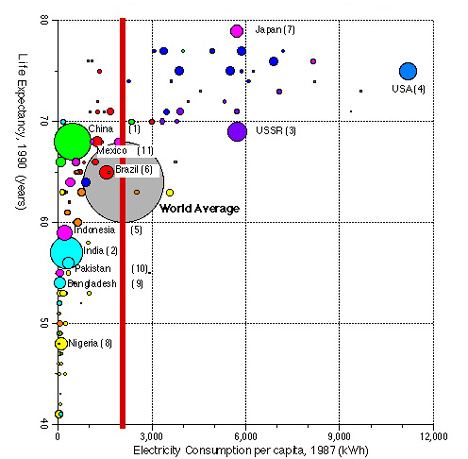
More energy usage gives us a longer life.  
If you take a look at electricity use versus lifespan, the Japanese are both lucky enough to have ample access to energy, but also efficient enough to squeeze the most lifespan out of it.  Again, as Americans, we're lucky.  We use a lot of energy, and we have a respectable lifespan, as well.  Modern healthcare (powered by energy), labor saving devices like dishwashers, washing machines, etc. all help us out and help us to live longer.

Source: Global Energy Network Institute

But this energy comes from some "dirty" sources
Powering our energy-rich lifestyle are three major sources: petroleum, coal, and natural gas.


And not all of our energy suppliers are our friends.
Most of our imported natural gas comes from Canada, with whom we're pretty friendly (except for during  Olympic hockey matches).   Petroleum, however, is another matter.  The US imported over 60% of it's oil in 2007.  After those friendly Canadians, the next largest exporter was Saudi Arabia- whose ruling class is generally friendly to us, but it is also home to many of  the people who brought down the World Trade Center on September 11, 2001.  Venezuela and Nigeria, also not very friendly to us, also exported a large amount to the US.  This fact causes energy security and national security-concerned people to seek out alternative sources of energy, preferably ones that we can produce entirely in our home country.


Another reason to look for alternate energy sources - carbon dioxide emissions
Since Americans use four times as much energy as the average world citizen, we also emit four times as much carbon dioxide, according to the World Bank.  Carbon dioxide is what's known as a "greenhouse gas" - it collects in the atmosphere and is thought to be driving the elevation in temperature that we showed on the blog yesterday.  


Transportation and electric power - the biggest drivers of carbon dioxide
Here in the western states of the US, the major carbon dioxide producers/energy consumers are transportation activities and electric power.


Source: Sightline.org

Walking beats the bus, which beats the Prius, which beats the car, which. . .
Since transportation is a huge contributor to energy usage and greenhouse gas emissions, it's often the primary target of conservation and alternative energy campaigns.  So until you can afford that all-electric Tesla Motors vehicle, here are some things to keep in mind.   Taking a bus can mean that you're responsible for only 1/6th the amount of carbon dioxide emissions than if you drove your car.  If you have a Prius (or a Nissan Leaf or hybrid Ford, etc.) you release about 1/2 the  amount of carbon dioxide into the air.

How do we become more Japanese?
Energy conservation and finding alternative energy sources clearly helps on two fronts: it limits our exposure to countries that don't particularly like us, and it reduces the amount of greenhouse gases that we put in the air.

But perhaps the question for the day is, what are the Japanese doing?  If Americans were more like the Japanese, they would use 50% less energy and also live longer.  Sounds like a good combination, considering the high quality of life that the Japanese have, as well. On that thought, here's a link to Sakura House, which can help you find a nice apartment in Tokyo.

Monday, April 19, 2010

How hot is it? An answer in 3 charts.

This Thursday, April 22nd, marks the 40th Anniversary of Earth Day.

So this week, we're taking a look at fascinating and compelling "executive dashboard" reports on the environment - earth intelligence instead of business intelligence.  Today, we're kicking it off with charts  from the National Climatic Data Center, NASA Earth Observatory, and the Intergovernmental Panel on Climate Change.

First, we try to answer the question. How hot is it?

The answer seems to be: plenty hot.

Here in the United States, the average termperature has risen from 52 Farenheit to 54 Farenheit, a rise of roughly 4% since 1900 (or about 1.4 degrees Centigrade).

It's not just us.
Taking a step back and looking at global temperatures, it appears that global temperatures are on the same trend.  The chart below, from NASA, shows that temperature anomalies have also been getting higher (i.e., hotter) since the early 1900s.  That's variation upwards of .5 degrees Centigrade from 1900 to 2000.


Source: NASA Earth Observatory

Is a rise of 0.5 degrees Centigrade a big deal?
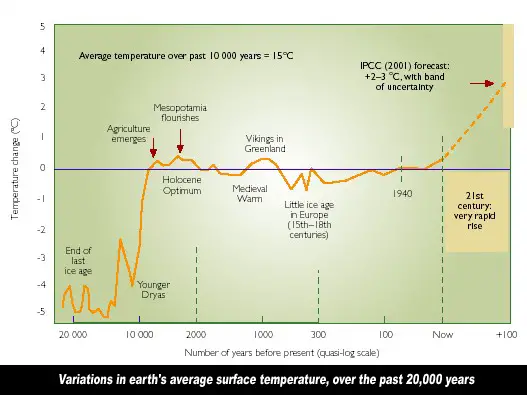
Apparently so.  The Intergovernmental Panel on Climate Change took a look at average temperatures, starting with tens of thousands of years back.  A depression in average temperature of less than 1 degree Centigrade was termed the "Little Ice Age" - this was around the 15th-18th centuries.

A really bad ice age is a downward variation of over 4 degrees Centigrade.


Source: International Panel on Climate Change

But we don't apparently need to worry about skinning mastodons for fur coats - we are going to be experiencing the opposite problem.  The IPCC forecasts that in the next 100 years the temperature will rise by 3 degrees Centigrade.

How will that impact us?
It already is impacting us, apparently, in dramatic ways.  In the summer of 2002, the Antarctic Peninsula lost 1,250 square miles (3,250 square kilometers) of ice shelf, in less than a month.

Collapse of the Larsen B ice shelf in 2002.  
Blue rivulets indicate streams of water.
For the full time-sequence images from NASA Earth Observatory, click here.


Closer to home, Glacier National Park just lost two of its named glaciers to melting.  In a decade, the remaining 25 named glaciers may also be gone.  In order for a glacier to be big enough to qualify for a name, it has to be at least 25 acres large.

Source: Associated Press

Matthew Brown of the Associated Press tracked down Dan Fagre of the US Geological Survey, who has been having a difficult time measuring the glaciers at all, due to their rapid rate of change:"When we're measuring glacier margins, by the time we go home the glacier is already smaller than what we've measured," Fagre said.

The impact of fewer glaciers is reduced water flow for fish and a much greater risk of forest fires.

Stay tuned for more Earth Day postings this week.