Tuesday, December 14, 2010

Dreamforce - cloudstorms, monkeys, and overheard

We're still recovering from a fantastic Dreamforce 2010 here at the Birst headquarters. We had over three times the number of people stopping by to chat about business intelligence this year, which is a great validation of how important powerful analytics are to salesforce.com customers.

There were so many clouds announced at Dreamforce 2010 that it started raining. 
The new cloud announcements during Marc Benioff's keynote seemed to have a cloud seeding effect. The energy and enthusiasm of the Dreamforce 2010 attendees stayed at a high level, though, and they seemed to revel in the cloudy weather.

Thanks to everyone who came by the Birst booth - sorry we ran out of monkeys. Here's how you can still get one.
The monkeys ended up being more popular than we expected, much to the chagrin of Birst employees who were hoping that there would be leftovers to take home.  If you missed your monkey, just arrange a sales call with one of our sales teams, and we'll be happy to give you a monkey as a thank you.  You can reach our sales team at 1 (866) 940-1496 or you can send us an email from our contact form - click here.

Overheard at Dreamforce
Dreamforce attendees are a fun crowd, and we heard a lot of amusing, enlightening, and thoughtful things over the course of the week.  Here are a few of them.

  • "No, really, I'm the Microsoft CTO." - inebriated Microsoft employee, trying to crash the Birst private party on Monday night
  • "You can never have too much flair." -  enthusiastic Dreamforce attendee, sporting no less than 12 salesforce.com event buttons, including "Repeat Attender"
  • "I was a Business Objects SI for years.  But on-premise BI is nowhere now." -  software systems integrator who stopped by the Birst booth to strike up a partnership conversation
  • "I wonder if they have cow socks, too." - attendee considering getting the type of socks that Marc Benioff was wearing for the Tuesday morning keynote
  • "I think I should go play the lottery now." -  Dreamforce attendee who picked up an orange Birst bag to carry the Microsoft Xbox Kinect that she won from Coupa and the iPad that she won from another Dreamforce sponsor
  • "Hey, you, get offa my cloud!" - attendee who was wondering when we would all have clouds, or if there should just be one cloud

Thanks again for a great Dreamforce 2010, we're looking forward to seeing you again next year!

Tuesday, November 30, 2010

Bringing SaaS BI to Dreamforce 2010

Just a few days left until Dreamforce 2010 and the excitement is building here at Birst HQ. Thousands of giveaways (of two different kinds!) are stacked up in our offices, thousands of collateral pieces are being printed, and our engineers are perfecting their sales analytics demos.
 
Here's where you can find Birst at Dreamforce, and how to make the most of what we'll have to offer.

Stop by Birst booth #1000 to see the latest and greatest in sales analytics and BI
Birst has a roomy booth this year, where you can check out our sales analytics, pipeline analysis, and general business intelligence demos.  You can also pick up some helpful datasheets and whitepapers while you're there.

Get some free Birst stuff
You have two hands, so we have a giveaway for each of them.  One will be very helpful for you at Dreamforce - practically everyone was asking for one last year-- so stop by early to pick it up during the Monday night reception.  You'll want to carry it around all week.  The other is soft, furry, and fun, and you'll want to make some space for it in your luggage. There are 20,000 people coming to Dreamforce and we only made a few thousand of each, so stop by early to get yours.  Once they're gone, they're gone.

Get a free "Pipeline Stress Test" for your sales forecast
As a 5 Star rated AppExchange partner and leading provider of sales analytics for salesforce.com customers, Birst is offering a free "Pipeline Stress Test" to Dreamforce attendees. The Pipeline Stress Test quickly analyzes a company's sales performance and provides an accurate, historically based forecast of how the current quarter will perform. A $3,000 value, the Pipeline Stress Test will be free to Dreamforce attendees. Interested salesforce.com customers can stop by the Birst booth to sign up.

Help raise money for the construction of the UCSF Benioff Children's Hospital - with just your signature!
Birst also invites you to show their support of children's health and the new UCSF Benioff Children's Hospital by stopping by the "UCSF Benioff Children's Hospital" booth, Booth #1215. For every attendee signature, Birst and its partners will provide a $5 donation towards the construction of the new children's hospital, for a total of up to $90,000. For more info on how you can help, click here.

We're looking forward to seeing you at Dreamforce!

Wednesday, October 27, 2010

Birst has got the Mo - Aspect the latest customer to tell the world why they picked Birst

The story about the value and power of SaaS BI is becoming louder and louder each day.  And it's not just Birst that's cheering.  It's our customers and partners, too.

We're honored that eleven customers and partners have recently announced to the world why they picked Birst as their SaaS BI provider.  And that's just in the past few months.

Here's our Summer and Autumn 2010 "customer pride" roll call:


Aspect
Birst's On-Demand Business Intelligence Solution Helps Aspect Enhance Ability to Forecast Business Performance
read more

PlusOne
Plus One Selects Birst’s On-Demand BI Solution to Help Clients Further Reduce Healthcare Costs
read more


Xactly
Xactly Chooses Birst to Provide Single View of Key Operational Data from Multiple SaaS Applications
read more
 
EMT
EMT Partners with Birst for Substance Abuse Reporting for California Counties
read more
 
PeopleAnswers
PeopleAnswers Selects Birst and Cervello for HR Analytics to Increase Clients’ ROI
read more
 
Massive Analytic
Massive Analytic and Birst Partner to Bring On-Demand Business Intelligence to EMEA
read more
 
Traiana
Traiana Selects Birst to Increase Insight into Sales and Professional Services Pipelines
read more


Mohawk
Mohawk Employees to Use Birst's Reporting and Analysis to Make Better, More-Informed Decisions
read more

Altair
Altair Uses Birst to Help Clients Improve Marketing Effectiveness and Customer Profitability
read more


KYDEX
KYDEX, LLC Speeds and Enhances Sales Reporting Using Birst's On-Demand BI Solution
read more
 
NPD Group
The NPD Group Selects Birst to Improve Sales Operations Insight and Efficiency
read more


We're very grateful for their public support of Birst and the power of SaaS BI. To find out more about SaaS Business Intelligence, check out the Birst "BI 101" section of the Birst.com website.  Click here.


Monday, September 20, 2010

Confirming the Case for SaaS BI

The Aberdeen Research Group has recently released a new report on SaaS Business Intelligence (SaaS BI), “Fast, Affordable, Agile – The Case for SaaS BI.”

The results confirm the benefits of SaaS BI – faster decisions, lower IT costs, and more pervasive use of business intelligence.

For example, companies that use SaaS BI are 50% more likely to have self-service BI users than organizations that adopt traditional, on-premise BI.  The implications of this are significant.  That’s a lot less people lining up outside the overworked IT guy’s door, hoping to get new reports.  And that’s a lot more people able to come up with quick answers themselves, so that they can take action.  It all adds up to a more proactive organization, doing more with less.

A couple more of Aberdeen’s takeaways, quoted directly from the report press release:
  • SaaS BI opens up business intelligence to new user populations -- In addition to helping small organizations overcome the initial cost and IT burden of traditional BI approaches, several factors are driving adoption of on-demand BI in large organizations, including: tight budgets, long, resource-intensive deployments for conventional approaches and diverse needs of many workgroups (tied at 38%). Aberdeen adds, "the single biggest factor is that conventional BI tools are simply too complex and hard to use," (58%) which it views as "a clear indication that the relative simplicity of SaaS BI tools presented via a browser is a strong driver of adoption."
  • SaaS changes the economics of BI deployments -- Aberdeen's study notes several economic advantages of SaaS BI over on-premise alternatives, including more flexible pay-as-you-go licenses and subscriptions, faster time to value, eliminating the expense of hardware investments, and availability of pre-packaged key performance indicators (KPIs) and metrics that "can significantly help in cutting the time and cost involved." 
  • SaaS encourages agile and flexible BI solutions -- Aberdeen concludes, "a number of capabilities that contribute to agility are related to self-service business intelligence -- the ability for business users to find the information they need without repeated trips to the IT department for assistance."
In a nutshell, with SaaS BI, more people get insight, BI costs less, you see value more quickly, and your solution is more responsive to your needs.

This allows new organizations to get BI that didn’t have it before, as analyst David White noted, "SaaS BI fosters self-service in many ways. It provides increased ability to automate the generation and distribution of reports, drill-down capabilities and the creation of automated alerts. It's also clear that Software-as-a-Service is finding favor with new user populations. Smaller organizations that need a step up from the humble spreadsheet and larger organizations that need to provide BI to underserved employees are both driving adoption."

For a free copy of the report, click here. 

Birst is a co-sponsor of this SaaS BI report.  We hope that you enjoy it. Get it soon.  The free download expires on October 31, 2010.

Wednesday, August 11, 2010

Feeling the stress of the quarter? Time for the Birst Pipeline Stress Test, free from Birst.

The quarter is nearly halfway over and September 30th is rapidly approaching.  You can see your current pipeline in your SFA solution, but how can you really know if you will make your forecast?  Some deals will drop out, some new deals will come in, and Salesforce.com is only telling you what a bunch of combined guesses add up to.

Want a more reliable predictor?  It's time to take the Birst Pipeline Stress Test.

The Stress Test gives you greater confidence in your forecast, since it tells you where you stand based on your actual historical results, not guesses.  The Birst Pipeline Stress Test Dashboard lets you know:
  •  What the historical odds are that deals at each stage will close or progress.
  •  A prediction of where the current quarter will end up, based on historical probabilities.
  •  A forecast of what proportion of deals will slip into the next quarter.
  •  A prediction of how new deals will likely affect current quarter pipeline.

The Stress Test helps you move beyond hunches to gain confidence in your current revenue trajectory. It's also fast - so that you can prioritize resources and maximize the probability of success for this quarter.


And it's free.

The Birst Pipeline Stress Test consists of three easy steps:
  1.  Apply. Birst will check to ensure that you have the information available to complete the Stress Test and both organizations will complete confidentiality agreements to protect your information and interests. 
  2.  Birst runs the analysis for you. We run the Pipeline Stress Test on your current Salesforce.com account. This process requires only a couple of days to complete. 
  3. Review your results. Birst reviews the forecast dashboard with you and shows you the actions that you should take to secure your quarterly sales outcome.
And did I mention that it's free?  Start to finish takes only 3 days, with no other commitments and no crazy IT requirements.  Getting started is easy.

The Birst Pipeline Stress Test is only available for a limited time. To see where you stand for this quarter, sign up for the Stress Test today.

The stress test shows the value of Birst's greater Sales Analytics solution and shows how SaaS business intelligence can provide rapid, actionable results.  

Tuesday, July 20, 2010

Delivering great BI to more of your organization - Birst announces concurrent user pricing

Today, Birst announced the availability of concurrent user pricing, Concurrent user pricing solves the challenge of delivering greater insight to a large number of potential users in an affordable way. A number of analysts that we spoke to regarded concurrent user pricing as one of the most requested features that customers have. However, BI companies wouldn't give it to them. Until now.

With concurrent pricing, organizations acquire licenses for the desired number of users that can access the solution at any one time. This means that a company only licenses the number of users active on the system, rather than the maximum number of named users who could potentially use the solution.

This is not the way that Big BI does business. Traditional on-premise business intelligence (BI) software solutions operate solely on a “named user” basis. The software is licensed to a particular, identified user and installed on their computer. The customer pays whether that person is actually using the software or not. In this situation, larger customers often end up paying for “shelf-ware,” software that is not actually used, and not everyone who could benefit from BI gets access to it. It's a lose-lose for the customer.

Many people can benefit from BI, but not everybody gets access to it
BI usage is typically around 8% of an organization, a surprisingly small figure. There are a number of things holding back the penetration rate of BI - cost and complexity of traditional deployments being the two leading issues. It's simply too expensive and too complicated to extend BI throughout an organization, when using traditional pricing models.

Concurrent user pricing - bringing BI to more people by lowering cost hurdles
Concurrent user pricing helps large organizations clear the pricing hurdle. In the old model, if you have 10,000 users who might benefit from the system, you had to pay for 10,000 licenses. This was simply too expensive. However, what if those users only used the system infrequently? Only 1,000 were on the system at any one time? Concurrent user pricing lets you pay for just those 1,000 open seats. Now 10,000 people get the benefit, while the company only pays for 1,000 open seats.

Birst is able to easily offer concurrent user pricing because it is an on-demand business intelligence solution. Since users access the solution over the internet, it's easy to see how many users are on the system at any given time. Traditional on-premise software can't do this, since the software has to be loaded on individual machines in order to be used.

On-demand BI - lowering the implementation complexity hurdle
The other hurdle to implementing BI broadly throughout an organization is the complexity of traditional solutions themselves. Extending to more users and meeting their ongoing analysis needs can be incredibly demanding of IT time and resources, due to the complexity of their systems. Birst is a fully integrated BI solution that is highly scalable. So if you want to add 100 more users, you can easily add 100 more users. If those users add new data, that's also easily done. Initial implementations are often done in 1/3rd the time and for 1/3rd the cost of traditional solutions. And with Birst's ease of use, those users can run analysis and reporting themselves, without over-reliance on IT.

Concurrent user pricing- expanding the market and delivering better value to customers
One journalist that we spoke with said that traditional BI vendors also doesn't like concurrent user pricing because it "leaves money on the table." Why ask a customer to pay for only 1,000 licenses when they have 10,000 potential users? Just make them pay for all 10,000. This doesn't pan out in the real world, however. Organizations simply decide that they won't pay that much. They'll only pay for 8% of users to get BI. Concurrent user pricing actually expands the market, by making BI affordable and easy enough to deliver it to to people who didn't get it before. It's capturing parts of the market that were locked out by traditional BI vendors.

Concurrent user pricing - it's just another way that Birst is focused on delivering a great BI experience for the customer.

Monday, July 19, 2010

There's an app for that -- get your Birst reports on smartphones

Now that you are getting your free bumper for your iPhone 4 and don't have to worry about losing reception when you hold your phone with your left hand, we wanted to let you know that you can now get your key Birst reports on your iPhone. Or your BlackBerry. Or your Android phone. In fact, any smartphone with a modern browser should be capable of displaying your Birst reports.

And your iPad, too.

So if you're on the commuter train, waiting in line at Starbucks, in the conference room of a major customer prospect, or on the factory floor, you can get the reports that you need, with the most recent information, no matter where you are.


Now you know, wherever you are.

Key features include:

  • The latest reports, automatically — Get the most recent reports, so you can see the exact status of the business and have up-to-date conversations with employees, partners, and customers.
  • Interactive analysis— Quickly and easily browse reports and dashboards to see exactly the information you need, drilling down interactively to any level of detail.
  • Real time data access – Analyze your data in real time. Customers using Birst Live Access, which directly accesses on-premise databases and can query data on-the-fly, have access to real-time data.
  • Alerts — Track exceptions and receive email alerts. If any critical business rule or threshold level is crossed, be immediately alerted and interact with Birst to diagnose and address the key drivers of the issue. For example, know when inventory has fallen below acceptable levels.
 

Easily filter results, to see just what you need.

Fully secure.  Birst Mobile is password protected and HTTPS, so only the report owners can see their Birst reports. 

Switching to a new phone? No problem.   Phones change rapidly, so users switch their phones frequently. With on-device BI solutions, this is a big hassle.  Business users have to surrender their phones to IT, assuming that the software will work with the new device.  And since many users are all switching phones at the same time, the wait can take a while.  Since Birst is an on-demand solution, upgrading phones is not an issue for IT or for the business user.  Simply log on to Birst using your new phone.  As long as the phone has a modern browser, your reports will be there. Birst makes mobile BI easy and powerful.

Tuesday, May 25, 2010

Bringing BI to midsize businesses - the necessary partnership between IT and business

Midsize organizations often struggle with transitioning to business intelligence.  As the business has grown, business users feel the increasing pain of reporting and analysis (or the lack of reporting) as data volume expands,  the sources of information multiply, and achieving even basic business insight becomes more complex and time consuming.   Despite this pain, they don't often understand that there is a better solution than cobbling together Excel spreadsheets or struggling with Microsoft Access.   
 The IT team understands the value of business intelligence, but is often pulled in multiple directions and doesn't have time to explain BI to business users, or engage in a lengthy, complex traditional BI deployment. 
Here are some process and technology tips on achieving a happy outcome for all - a partnership between business and BI that gets reporting needs addressed, makes effective use of IT's precious resources, and ensures that the organization has a solution that will continue to serve its needs as the business changes.
IT makes the case -- the business case
IT can ride to the rescue of the business when it can speak in the language of the business user. So to move BI from the "nice to have" column to the "necessity" column, IT needs to make the case that BI is mission critical, as Cindi Howson points out in her recent InformationWeek article.

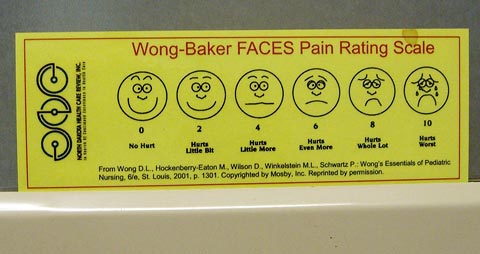
  • Give the pain a name and an intensity.  At the doctor's office, a nurse often shows you a pain classification chart, from smiley face (not painful at all) to a crying, frowning face  (excruciating pain).  This helps gauge what kind of solution is necessary.  When kicking off a BI project, making a pain assessment can be helpful.  For each department, calculate what it costs analysts to do a number of business processes manually versus the cost of automating it with business intelligence.  This doesn't have to be overly involved - the labor costs of manual calculation alone are often compelling enough to consider BI.

  • Identify the key pain points.  Just like in acupressure massage, you don't need to treat the whole body for pain, just the key points.  Gather the key metrics from each affected group, to ensure that you're answering the right questions - the ones that bedevil them every week.  Avoid scope creep by focusing on the current set of desired metrics from manual calculation, and expand only a percentage from there.

 Don't solve for everything at once.  Massage the critical pain points.
  • So this is what relief looks like!  Imagining a BI-powered future can be a leap for some business users, who may not like the current system, but are comfortable with it.  Marshal some statistics on how BI can improve decision-making and business results, without requiring large expense or deployment times.  For example, Aberdeen is offering a free report for a limited time about the TCO of Business Intelligence.  There are some great stats in here.  For your free copy, click here.

Coming together on BI strategy 
Once the business sees the potential value of BI, IT and business need to work together on creating a cohesive BI strategy for their particular case.  This is a key piece, as IT executive acknowledged at the recent Gartner Business Intelligence conference.  Main topics for discussion include:

  • Key phases of the project and the goals for each
  • Ensuring user adoption through training, deliverable requirements, and business process/culture
  • Ongoing BI governance

Make sure that your solution meets the needs today and is future proof for tomorrow 
Once the business case is made and the strategy is set, the last component is the technology.   This is often an insurmountable hurdle for midsize businesses, since traditional BI solutions are often too expensive, complex, and IT resource intensive to be feasible. 
However, new BI solutions can help to overcome these hurdles and deliver on the BI requirements and strategy.  The three options available to the midsize organization are on-demand business intelligence, in-memory analytics, and open source BI tool technology. While all three are vastly more affordable than traditional BI, on-demand BI offers the most flexibility to meet increasing complexity and scale as a business grows. 
On-demand business intelligence is faster to deploy than traditional solutions, often in weeks instead of months. It's also more affordable.  As a monthly subscription that is only a fraction of the cost of traditional solutions, companies can avoid large upfront costs and only use what they need at that particular time. It also provides superior flexibility and scalability.  There is no additional hardware to buy or IT resources required as  the solution grows, and many solution, like Birst, can handle any data source that you throw at it, so it is extensible to multiple departments in your organization. 
With the right mix of IT/business partnership, strategy, and technology, midsize organizations can finally achieve the business insight that they need. 


Thursday, April 22, 2010

The importance of 350 - and doing something about it

Happy Earth Day.  For today's environmental dashboard series, we're focusing on one number in particular: 350.

350 is a "tipping point" number.  It is the safe upper limit for carbon dioxide in our atmosphere.  Below 350 ppm,  the climate continues to be hospitable to the lives that we enjoy living - lives with comfortable temperatures, mild weather, arctic ice, predictable ocean flows, and happy coral reefs teeming with life.

Above 350ppm, there are very negative consequences - extreme weather, droughts in some places, unpredictable ocean flows, dying coral reefs, diminishing ice in the Arctic and Antarctic, the loss of Pacific Island nations, and so on. 

The bad news: we're already at 387ppm, well past 350.

The good news: we can still do something about it.  Like someone who's just been told that they've put on 20 pounds too many for good health, we can start working towards diminishing the carbon dioxide in the atmosphere.


Hey, where did this 350 come from, anyway?
Up until late 2007, an upper limit number didn't really exist.  There were some guesses, such as doubling the amount of carbon dioxide concentration in the atmosphere from the Industrial Revolution days, and calling that it.  After seeing the dramatic reduction in Arctic Ice during the summer of 2007, a number of scientists decided to take a more thorough approach.


NASA's Jim Hansen, along with a team including Makiko Sato, Pushker Kharecha, and Valerie Masson-Delmotte, among others, took a close look at historic data and determined that 350 is the safe upper limit.  The report that they produced is publicly available, you can download it here.  If you find the technical terms a bit confusing, check out the really compelling summary on the last few pages.

So what do we do about that?
There's a lot that everyone can do, both as individuals and as nations.  As the United States, we're in the best position to do something, since we're both one of the largest energy consumers and one of the largest emissions producers.

As an individual
  • Be conscientious about energy consumption.  Not only turning off unused lights and limiting unnecessary electricity use, but also reconsidering things like your daily commute.  Perhaps the bus does take 15 minutes longer, but it may be worth it.
 
  • Consider the climate impact of the goods and services that you consume.  In the Bay Area, more and more restaurants are indicating on their menus which options are environmentally friendly.  It doesn't mean that you always have to choose those options, but awareness can often drive action. 
 
  • Offset your carbon usage.  Organizations like CarbonFund.org make it easy for you to purchase carbon credits to offset your energy usage and emissions.  I offset the average carbon usage for my family today.

As a country
It's going to take concerted effort to reduce atmospheric carbon dioxide levels to within the safe range.  That calls for national solutions in addition to local and individual ones. Here are some ways to get involved:
  • Check out 350.org  350.org is a helpful site with information about the 350 movement and how you can take action. 

For more info, here are some great resources:

Wednesday, April 21, 2010

Ode to the blue bin - America's wastestream and what we're doing about it

Continuing our 40th Anniversary of Earth Day series, here's an executive look at what happens to all of our stuff after we think that we're done with it.

We have a lot of stuff, we have a lot of trash
Along with the rise in American disposable income and wealth over the past century has come a rise in what we dispose of.  As the Environmental Protection Agency calculates it, the amount of solid waste generated in a year has gone from 88 million tons in 1960 to nearly 250 million tons today.

And it's not just because there are more Americans.  The amount of trash generated each day by an American has gone from 2.7 pounds to 4.5 pounds in the same period.  In a year, that adds up to 0.8 tons per person.


Hey, you can see our trash from space!
There are two man-made constructions that you can see easily from space.  One is the Great Wall of China.  The second is the Fresh Kills landfill site on Staten Island,the repository of New York City trash since it opened in 1948.  It's 2,200 acres of fun, rising to 225 feet in some spots.  Now turned into a park, it looks rather pretty now, but I wouldn't go digging too deep.

We are running out of landfills, however, for all of our trash. From 1979 to 1995, the number of landfills dropped by 84%.  Landfills are closing at the rate of 1 per day, according to the Clean Air Council.

What is all this stuff?
The majority of what we throw out is made up of paper, followed by yard trimmings, food scraps, and plastics. 


Seen in another way, a lot of what goes into the waste stream is -- packaging.  That's your aluminum can, your disposable grocery bag, your takeout food container. We do love convenience.  According to the Clean Air Council, Americans throw away 2.5 million plastic bottles every hour.  Americans toss out enough paper and plastic cups, forks and spoons every year to circle the equator 300 times.

 
2.5 million plastic bottles are thrown out every hour.

And that's just the small stuff.  Every day, 20,000 American cars and 4,000 trucks and buses are disposed of.


The good news - we can recycle a lot of this, and we are doing more and more of it
 Americans now recycle about 83 million tons of discarded material a year.  This is a huge growth since the early 1980's.  About 1/3rd of waste is now headed to the recycler.

In 1980, 89% of all waste ended up in a landfill.  Today, it's only 54%.  Recycling, composting, and incineration take care of the rest.
Recycling has a huge impact on reducing energy use and emissions. The 83 million tons of waste recycled last year is equivalent to reducing 182 million metric tons from our environment, comparable to the greenhouse gas emissions from over 33 million cars. It also save the equivalent of over 10 billion gallons of gasoline.


There's still more we can do
 Awareness, recycling programs, and legislation have all helped to increase recycling rates.  However, there's still more that can be done.  While almost all auto batteries are recycled (a great example of adherence to the law), more recycling of personally used products, like cans, glass containers, and plastic containers can be done.  The following chart from the EPA shows that only 28% of glass containers are recycled, and only 48% of aluminum cans.
Every can important
According to the Clean Air Council, recycling a single aluminum can saves as much energy as if that can were half full of gasoline.

 That's equivalent to 18 oz. of gasoline, right there. 

So as you gear up for Earth Day tomorrow, please take a moment to think about your 4.5 pounds of trash, and recycle as much as you can.

Tuesday, April 20, 2010

Energy - the ups, the downs, the benefits of being Japanese

Today, for our 40th Anniversary of Earth Day series, let's take a quick look at energy usage and its implications with a series of charts.

As Americans, we're lucky.
We have ample access to multiple types of energy sources, and we make use of it.   According to the World Bank, the average American uses  nearly 4 times as much energy as the average World citizen.  That goes to the comfortable modern lifestyle of gasoline-powered transportation, heated homes, air conditioners, electronic devices, etc.


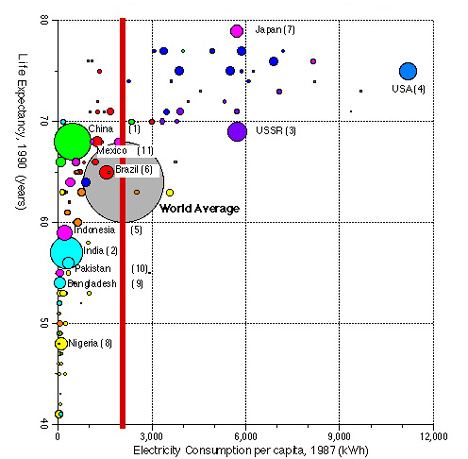
More energy usage gives us a longer life.  
If you take a look at electricity use versus lifespan, the Japanese are both lucky enough to have ample access to energy, but also efficient enough to squeeze the most lifespan out of it.  Again, as Americans, we're lucky.  We use a lot of energy, and we have a respectable lifespan, as well.  Modern healthcare (powered by energy), labor saving devices like dishwashers, washing machines, etc. all help us out and help us to live longer.

Source: Global Energy Network Institute

But this energy comes from some "dirty" sources
Powering our energy-rich lifestyle are three major sources: petroleum, coal, and natural gas.


And not all of our energy suppliers are our friends.
Most of our imported natural gas comes from Canada, with whom we're pretty friendly (except for during  Olympic hockey matches).   Petroleum, however, is another matter.  The US imported over 60% of it's oil in 2007.  After those friendly Canadians, the next largest exporter was Saudi Arabia- whose ruling class is generally friendly to us, but it is also home to many of  the people who brought down the World Trade Center on September 11, 2001.  Venezuela and Nigeria, also not very friendly to us, also exported a large amount to the US.  This fact causes energy security and national security-concerned people to seek out alternative sources of energy, preferably ones that we can produce entirely in our home country.


Another reason to look for alternate energy sources - carbon dioxide emissions
Since Americans use four times as much energy as the average world citizen, we also emit four times as much carbon dioxide, according to the World Bank.  Carbon dioxide is what's known as a "greenhouse gas" - it collects in the atmosphere and is thought to be driving the elevation in temperature that we showed on the blog yesterday.  


Transportation and electric power - the biggest drivers of carbon dioxide
Here in the western states of the US, the major carbon dioxide producers/energy consumers are transportation activities and electric power.


Source: Sightline.org

Walking beats the bus, which beats the Prius, which beats the car, which. . .
Since transportation is a huge contributor to energy usage and greenhouse gas emissions, it's often the primary target of conservation and alternative energy campaigns.  So until you can afford that all-electric Tesla Motors vehicle, here are some things to keep in mind.   Taking a bus can mean that you're responsible for only 1/6th the amount of carbon dioxide emissions than if you drove your car.  If you have a Prius (or a Nissan Leaf or hybrid Ford, etc.) you release about 1/2 the  amount of carbon dioxide into the air.

How do we become more Japanese?
Energy conservation and finding alternative energy sources clearly helps on two fronts: it limits our exposure to countries that don't particularly like us, and it reduces the amount of greenhouse gases that we put in the air.

But perhaps the question for the day is, what are the Japanese doing?  If Americans were more like the Japanese, they would use 50% less energy and also live longer.  Sounds like a good combination, considering the high quality of life that the Japanese have, as well. On that thought, here's a link to Sakura House, which can help you find a nice apartment in Tokyo.

Monday, April 19, 2010

How hot is it? An answer in 3 charts.

This Thursday, April 22nd, marks the 40th Anniversary of Earth Day.

So this week, we're taking a look at fascinating and compelling "executive dashboard" reports on the environment - earth intelligence instead of business intelligence.  Today, we're kicking it off with charts  from the National Climatic Data Center, NASA Earth Observatory, and the Intergovernmental Panel on Climate Change.

First, we try to answer the question. How hot is it?

The answer seems to be: plenty hot.

Here in the United States, the average termperature has risen from 52 Farenheit to 54 Farenheit, a rise of roughly 4% since 1900 (or about 1.4 degrees Centigrade).

It's not just us.
Taking a step back and looking at global temperatures, it appears that global temperatures are on the same trend.  The chart below, from NASA, shows that temperature anomalies have also been getting higher (i.e., hotter) since the early 1900s.  That's variation upwards of .5 degrees Centigrade from 1900 to 2000.


Source: NASA Earth Observatory

Is a rise of 0.5 degrees Centigrade a big deal?
Apparently so.  The Intergovernmental Panel on Climate Change took a look at average temperatures, starting with tens of thousands of years back.  A depression in average temperature of less than 1 degree Centigrade was termed the "Little Ice Age" - this was around the 15th-18th centuries.

A really bad ice age is a downward variation of over 4 degrees Centigrade.


Source: International Panel on Climate Change

But we don't apparently need to worry about skinning mastodons for fur coats - we are going to be experiencing the opposite problem.  The IPCC forecasts that in the next 100 years the temperature will rise by 3 degrees Centigrade.

How will that impact us?
It already is impacting us, apparently, in dramatic ways.  In the summer of 2002, the Antarctic Peninsula lost 1,250 square miles (3,250 square kilometers) of ice shelf, in less than a month.

Collapse of the Larsen B ice shelf in 2002.  
Blue rivulets indicate streams of water.
For the full time-sequence images from NASA Earth Observatory, click here.


Closer to home, Glacier National Park just lost two of its named glaciers to melting.  In a decade, the remaining 25 named glaciers may also be gone.  In order for a glacier to be big enough to qualify for a name, it has to be at least 25 acres large.

Source: Associated Press

Matthew Brown of the Associated Press tracked down Dan Fagre of the US Geological Survey, who has been having a difficult time measuring the glaciers at all, due to their rapid rate of change:"When we're measuring glacier margins, by the time we go home the glacier is already smaller than what we've measured," Fagre said.

The impact of fewer glaciers is reduced water flow for fish and a much greater risk of forest fires.

Stay tuned for more Earth Day postings this week.


Tuesday, January 5, 2010

Getting out the Crystal Ball - Interesting Predictions for 2010

At this time of year, one of my favorite things to do is see what predictions people have for 2010. Here are some interesting ones that I've collected so far:

The JD Edwards Advisor blog- mostly focused on JD Edwards/Oracle predictions, but does have one of my favorite predictions:
  • "Cloud computing hype will rise, but adoption will be limited within our community. BI will be one area where it will start to catch on."
Enterprise Irregulars, predictions on BI from Nenshad Bardoliwalla. My favorite is his prediction #5:

"5. SaaS / Cloud BI Tools will steal significant revenue from on-premise vendors but also fight for limited oxygen amongst themselves. From many accounts, this was the year that SaaS-based offerings hit the mainstream due to their numerous advantages over on-premise offerings, and this certainly was in evidence with the significant uptick in investment and market visibility of SaaS BI vendors."

Your future is in the Cloud

Gartner's Top 10 Strategic Technologies for 2010, Gartner Group. The top 2 are:
  1. Cloud computing. Organizations should think about how to approach the cloud in terms of using cloud services, developing cloud-based applications and implementing private cloud computing environments. "Everything will be available as a service," Cearley said. "That doesn't mean you use it all [or] move it all there."
  2. Advanced analytics. Real-time data analysis will enable fraud detection on one hand and prediction and simulation on the other, as organizations use data to look ahead.
And another one from the Gartner Group, predicted in 2009 for 2010:
"By 2010, 20 percent of organizations will have an industry-specific analytic application delivered via software as a service (SaaS) as a standard component of their BI portfolio. "

Hmm. . . I think I'm noticing a trend!

And I feel compelled to post some interesting predictions from Saxo Bank's annual "Outrageous Predictions for 2010" list:
  • Gold will fall to $870 in 2010 but will rise to US$1500 in 2014
  • USDJPY to reach 110
  • The price of sugar will drop one third
As you can see, they're unusually heartwarming this year.